Cougar dating scams can follow the same romance-scam patterns found across online dating. A convincing age-gap profile is not proof of a real person, but an awkward message or an unusual age difference is not proof of fraud either. The useful question is what the other person asks you to do: open an unverified link, reveal private information, send money, or ignore your own doubts.
This guide gives both older women and younger men a practical way to check a new connection before paying or sharing anything sensitive. It draws on FTC romance-scam guidance and FBI warnings about AI-assisted fraud. We have not tested individual profiles or measured scam rates on any dating service. A report about scam tactics should not be read as an allegation against every member of a particular site.
Start by separating three different problems
People often call every frustrating dating experience a “scam,” but the remedy depends on the problem. A person-to-person romance scam involves an impersonator building trust and then asking for money, access or sensitive material. A platform purchase decision is different: Credits, memberships and add-ons may be costly, but their existence alone does not make a member fraudulent.
A poor local match pool can waste money without anyone deceiving you. Our CougarLife Credit budget guide addresses the second problem; this article focuses on identifying the first while checking the third before you spend.
- One polished photo or a sparse profile: Weak evidence either way. Ask a normal, specific question and look for consistent answers over time; do not pay to resolve uncertainty.
- A quick move to another app or “verification” site: A warning sign when paired with urgency or a card request. Stay on the dating service while you assess the person, and find support or account settings yourself rather than using a member-sent link.
- Money, gift cards, cryptocurrency or an investment request: A strong stop signal. Do not send funds or financial details; end contact, report the profile and preserve messages.
- A threat to share private images unless you pay: Extortion. Do not pay or send more images; save the evidence, report the account and contact law enforcement.
The three-gate check before a first payment or private disclosure
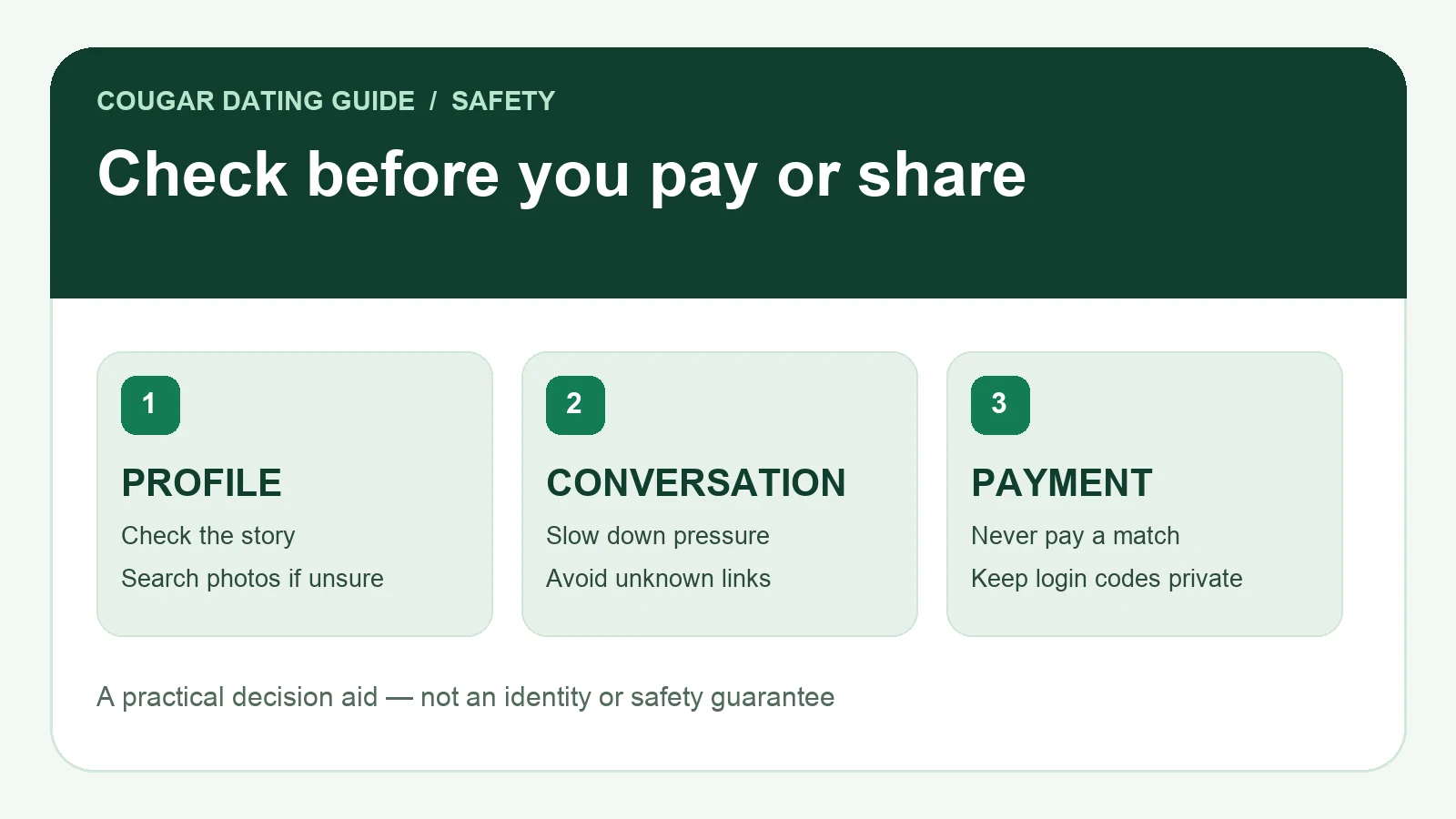
Gate 1: Does the profile behave like a person with a real life?
Read more than the age and photo. Is the stated location compatible with the conversation? Can the person answer a question about an interest they chose to list? Are their answers consistent when you talk again? None of these checks proves identity, and a real person can be brief or cautious. Use them to slow down a rushed decision, not to score someone on a checklist of stereotypes.
The FTC suggests a reverse image search when a profile seems suspicious. A photo appearing under another name or with incompatible details is useful evidence. A clean search is not an all-clear: the FBI warns that AI-generated images and text can support convincing fake identities. A video or voice call may add context, but it also does not establish that the person is safe, honest or locally available.
Gate 2: Is the conversation becoming urgent or isolated?
The FTC describes scammers moving conversations off dating apps, building emotional intensity and introducing a reason they cannot meet. Its examples include travel, military service, medical emergencies and investment opportunities. Any one detail can be true in a genuine life; the pattern matters when it leads to secrecy, time pressure or a request for money. You can decline an outside link or call without owing an explanation.
Be especially careful with a link described as “age verification,” “safety clearance” or “identity confirmation” if it arrives from another member and asks for your card number or login code. Use the platform’s own settings or support page through a URL you navigate to independently. The FTC says a request for your one-time account verification code is a scam signal; that code is for your login, not for proving yourself to a match.
Gate 3: What exactly are you being asked to pay for?
A legitimate site may charge for messages or membership. Confirm the charge inside the official checkout, identify the full amount and renewal or top-up rules, and decide whether enough relevant nearby profiles justify it. That is a consumer decision about the service.
Money requested by an individual match for a ticket, emergency, investment, gift card or “release fee” is a separate risk. The FTC’s plain rule is not to send money or gifts to an online love interest you have not met in person.
Meeting someone does not make later financial pressure safe, either.
Use a spending limit to avoid paying repeatedly for uncertainty. Before buying Credits or a subscription, write down the amount due today, what it lets you do, any automatic renewal or top-up, and when you would stop if the local pool is weak. Our site comparison and reviews explain the different paid models; none can verify the people in your area for you.
Apply the checks to two easily confused situations
Situation A: A match says you must visit a separate “safety verification” page and enter a card before meeting. The request comes from another member, outside the platform’s own checkout. Pause, do not use the link, and check the platform’s help or account area by navigating there yourself. If the person insists, report the profile. The problem is the member-directed destination and pressure, even if the page uses reassuring words or a familiar logo.
Situation B: The dating service itself offers a paid message plan in its normal account checkout. That is a purchase decision, not evidence that a particular match is authentic. Check the price, what the plan unlocks, renewal terms and cancellation route before paying. If the local pool is too small or the terms are unclear, you can leave without buying. Do not confuse a payment to the service with a payment to a person you met there.
These are hypothetical examples, not accounts we tested or claims about any named platform. The distinction is where the request originates, what it asks you to disclose and whether you can independently verify the terms.
Why age-gap stereotypes make poor fraud tests
A younger man being contacted first, or an older woman preferring privacy, is not in itself suspicious. Using age, gender or attractiveness as a shortcut can both stigmatize genuine people and miss a polished impersonator. Focus on observable behavior: inconsistencies, outside links, requests for credentials or money, repeated excuses to avoid ordinary verification, and threats. Keep your own boundaries consistent regardless of who initiated the conversation.
The same rule protects personal information. Use a unique password and avoid posting a phone number, workplace, home address or photo that reveals more than you intend. Do not share intimate images because a new match promises they will remain private. If you later decide to meet, use the ordinary safety steps in our online-to-offline dating guide: a public place, an independent way home and someone you trust aware of the plan.
What to Do If You Suspect a Dating Scam
- Stop contact and do not send more money or information. Avoid arguing with the account; preserve screenshots, usernames, links, payment receipts and chat records before blocking it.
- Contact the payment provider immediately if you paid. The FTC’s recovery guide gives different steps for cards, bank transfers, payment apps, gift cards and cryptocurrency. A refund is not guaranteed, but prompt reporting can matter.
- Secure any account information you disclosed. If you entered a password or one-time code on a member-sent page, go to the real service through your own bookmark or app and follow its recovery process. Change the affected password and any reused password, review account activity, and enable two-factor authentication if available. The FTC explains these account-recovery steps. If you supplied card details, also contact the card issuer through its official channel.
- Report the account to the dating service and the fraud. U.S. readers can use ReportFraud.ftc.gov and, for internet crime, FBI IC3. The IC3 advises retaining original evidence securely because it does not accept attachments with the initial complaint.
- If someone threatens to share intimate images, do not pay. The FTC’s image-based abuse guidance explains reporting and removal options. Tell someone you trust and contact law enforcement. Ignore anyone who demands an upfront “recovery” fee; the FTC warns about follow-on recovery scams.
If you are outside the United States, report the incident to the platform, your payment provider and the appropriate local authority. If you or someone else is in immediate danger, call local emergency services. U.S. reporting links here are given because this guide is written primarily for a U.S. audience; they are not the only routes to help.
Frequently asked questions
Are cougar dating sites full of fake profiles?
We do not have reliable, comparable scam-rate data for individual cougar dating sites. Fake profiles and impersonation can occur on dating apps and social media generally. Assess a specific profile’s behavior and the platform’s reporting controls instead of assuming a brand or age group is safe or unsafe.
Can a verified badge prove a profile is safe?
No. A verification feature may check one attribute at one point in time, depending on the service, but it cannot prove intentions, financial honesty or future behavior. Read what that platform says its badge actually verifies.
Is a request to leave the app always a scam?
No. Some genuine people prefer another channel. Treat an immediate move combined with a suspicious link, secrecy, financial request or pressure as a reason to stop. You can keep communicating on the platform until you are comfortable.
Does a reverse image search catch AI-generated profile photos?
Not reliably. It can expose reused or stolen images, but a photo with no matches can still be fabricated or misleading. Combine that check with conversation consistency and a strict boundary against sending money or credentials.